YouTube's Mainstream Report, the 2026 Emmys, and Tubi: Why Feeling Is How Culture Travels in 2026

Mainstream Culture Didn't Die. It Just Moved Downstream From Niche. Research Proves.
Why it Matters
According to YouTube and NRG, mainstream culture didn't disappear. It just changed direction.
The old model moved top-down. A studio, a network, a label, or a major brand declared something important, and the audience received it. The new model moves the opposite way. Something begins in a niche community, gains momentum through participation and lore-building, and eventually breaks through to wider audiences. The mainstream is no longer the origin point. It's the destination.
The Backrooms is the clearest proof of concept. A photo. A fan community. A YouTube series. A global box office record.
That's the new pipeline.
Food for Thought
The most important thing to pause on isn't the numbers. It's the direction of how culture travels nowadays.
Fandoms and niches have found their own way to surface. To the point where the audience is no longer waiting to receive the cultural moment. It's the space where the cultural moment is being written.
For communicators, this demands a genuinely different way of thinking about where a campaign begins. Which community cares enough to keep the story alive? Forget for a moment about the press release or the red carpet. Build the story from a place of community. Not by building one from scratch, but by finding the one that already exists and giving it something worth carrying forward.
The brands and campaigns that will travel furthest in this environment aren't the ones with the biggest footprint. They're the ones with the cultural intelligence to find the pockets where their content will actually thrive. The ones that gave a community something worth surfacing.
The campaign isn't chasing the built moment. It's chasing the engagement moment.
So the question worth sitting with: should we stop measuring success in terms of visibility and start thinking about it in terms of community strength?
The Emmys: Yes, Apple TV Won 28. The IP Strategy Is Building a Floor, Not a Ceiling.
Why it Matters
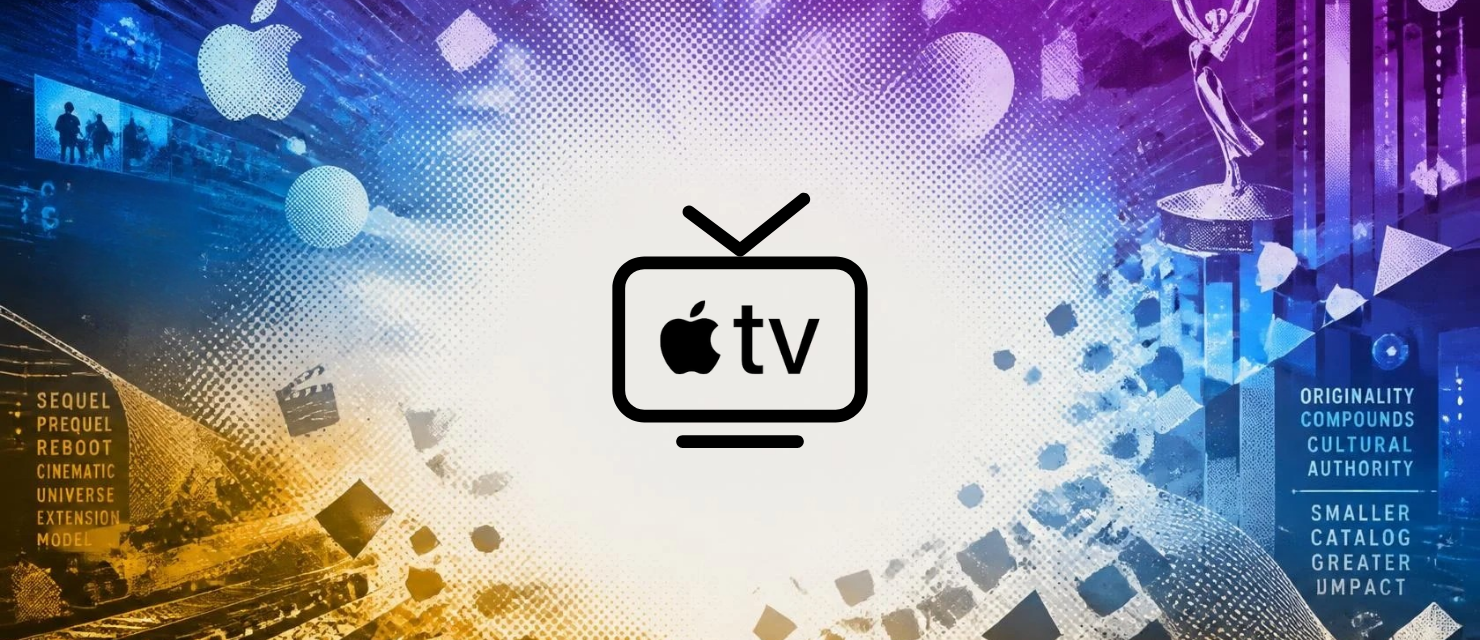
Apple TV led all networks at the 2026 Emmys with 28 total wins. Widow's Bay set a record for most Emmy wins by a comedy in a single season with 14, breaking the prior record of 13 also set by an Apple series, The Studio, just last year. Pluribus, Slow Horses, Palm Royale, Margo's Got Money Troubles. All Apple. All original. None of them a sequel, a prequel, a reboot, or a cinematic universe extension.
Disney collected zero Primetime Emmy wins. Prime Video collected zero.
That contrast is the story. Not the trophy count.
Because both spent the last five years building content strategies heavily anchored in established IP, sequels, spinoffs, and franchise continuations. Apple TV took the opposite position. They built their entire award-winning roster on original stories that didn't exist before someone decided to make them.
And the 2026 Emmy results are the clearest evidence yet that the IP-heavy model has reached a point of diminishing critical and cultural returns.
Why? Because mainstream is no longer constructed from the top down. As we explored in before (see article above), culture now travels the other way. It surfaces from communities, from niches, from original ideas that earn their audience rather than inherit one. The franchise model was built for a world where the mainstream was handed down. That world is over. And the Emmy board just voted on it.
Food for Thought
Now, don't get me wrong. Legacy IP provides a floor. It guarantees a baseline audience who already has an emotional relationship with the world. But a floor is not a ceiling. And the brands that have been optimizing for the floor are now watching Apple build cultural authority from the ceiling down.
The deeper strategic lesson here isn't about awards. It's about where cultural authority is accumulating. And cultural authority is what converts a streaming service from a utility into a destination. I still silently cry over what Warner Bros. Discovery has done to HBO.
Apple TV is the smaller catalog and the underdog by a mile. And yet Apple decided early that the way to compete wasn't to out-franchise the franchises. It was to repeatedly prove it had the taste to create new ones. If you don't believe me, ask the Silo lore community.
So for me the question now sits here: is your content strategy building a floor or a ceiling? Because how we communicate that and reach the audience has resonance. The audience that shows up because you keep surprising them is the one that builds cultural authority that compounds.
Originality no longer seems like a creative preference. In 2026, it has become the brand strategy.
Tubi Figured Out What Many Streamers Keep Forgetting: Feeling Is the Product
Why it Matters
Tubi just launched its first-ever global brand campaign. "Find Any Feeling For Free." And for this campaign they understood something. Everything you do is to feel something. Tubi decided to dial into your mood.
The strategic insight driving the campaign is rich. People don't choose what to watch based on what's available, even if we doom scroll through an extensive catalog because we don't know what to watch. They choose based on how they want to feel.
Food for Thought
What Tubi is doing here connects directly to everything this edition has been building toward. Which is why I left it for last.
Because Tubi, a platform with 110 million users, is telling the world that the entire reason anyone watches anything is to feel something.
The value proposition isn't "we have more content than you can watch." It isn't "we have better content." It's "we understand why you watch in the first place." As a brand positioning, that's brilliant. Because every other lane in the streaming ecosystem is already occupied. Tubi is “selling” emotional permission. The freedom to wander, try something strange, go deep on a specific obsession, and change your mind without every choice having to justify a subscription.
For me, the Tubi campaign is a reminder of something the streaming industry has been slowly forgetting in its race to accumulate catalog and win award shows. Audiences don't have a relationship with platforms. They have a relationship with how a platform makes them feel. Through the content.
Stay with that for a moment.
Feeling is the product.
Other Facts this week
🎮 See what happens when a city's brand collides with one of gaming's most controversial franchises — Miami Beach's GTA VI marketing deal is drawing real backlash from residents.
📱 Read why Meta One could change everything about how Instagram and Facebook make money — paid subscriptions are now officially in the mix.
🔊 If you're building a brand, note this — Sonos is going all-in on honesty and a full identity reset to recover from one of the most public product failures in recent memory.
🧪 Quick takeaway: STEM content is dominating YouTube because it holds attention longer — and that's a signal worth stealing for any creator or brand in long-form video.
🦸 Check how Avengers: Doomsday crossing $50M in pre-sales before opening weekend makes the case that IP-driven franchises still know how to command a crowd.